Inflation, a term that is often overlooked by people in modern days unless they possesses financial knowledge. Inflation is a pest in your treasure chest, a rat in your piles of cash. It is eating up your worth. You could be wondering, hey my cash is still there, and my bank account gives interest. My money in the account is growing more and more, how could there be a rat? So, what is inflation?
Inflation is a reduce of purchasing power of a currency. An inflation rate of 3% would mean that whatever cost $1 last year would need $1.03 to buy. The value of the money fall as more money is required to buy the same thing compared to last year.
Imagine just by a 3% inflation rate, the stack of $10,000 cash you keep under your mattress today, would only worth $ 8,626 in 5 years time compared to today's value. Imagine after 5 years you bring the same stack of cash to the grocery, you can only fill your shopping cart with what you can buy with $8,626 today.
How reliable official data is?
The real problem is, the inflation data is often published by federal bank or finance ministry after taking a the mean price movement of important living needs items such as food, cost of education, cost of transportation, housing prices etc. Of course they have professional team of mathematicians and economist to help them in reducing the chances of error, but still the number can hardly represent the inflation if a specific area in a country. Take a simple example, the price changes of property in Kuala Lumpur City Center and Cheras can be different in that same year. The price of flour may increase by 2%, but the price of noodles in hawker centers increases differently; some even increase a hefty 10% for a mere 2-3% increase in flour price or petrol price, as if their noodles are made of petrol. Therefore. the reliability and practicality of this data is really questionable when comes into real life application.
According to Bank Negara Malaysia, our inflation for past one year as at January 2016 was 3.5%, while everyone knows that the country has just implemented a 6% GST to most of the consumer items and services. Despite there is a drop in global petrol price by near 50% (USD 75 bbl to USD 30 bbl), the price of petrol in the country did not drop as much. In practical, the composition of every family's expenditure can be very different. Tom's family may spend 50% on property and 20% on food, while Peter's family will spend only 30% on property and 40% on eating out. Therefore, the inflation figure is just a comforting figure, where in actual life, the damage can be far bigger.
The FD interest rate in Malaysia is around 3.5% to 4% last year. In this scenario, it is not even enough to cover the rise of living cost from GST implementation. Is it really a wise choice to save all our money in the bank? Of course not! We need to have a balanced portfolio,
Like us on Facebook to get updates on new articles! In the coming articles, we will learn to allocate funds to hedge against inflation.
Today, most people are struggling through the day in the office. It feels as if 24 hours per day is not enough for them to finish their work. They feel busy all day but at the end of the day, accomplish less than they thought. At the end of the day, they realized that they are not closer to their objective.
If you think that the above description is talking about you, the tips below are for you.
7 Tips to Improve Productivity
1. Sleep early. Staying up late will cost your your cognitive power the next day and leave you lethargic all day. When your brain cannot work fast, it is basically impossible for you to be productive.
2. Understand your goals. Without a proper goal, you will have no direction and take whatever task thrown at you. Learn to identify what is important to you and what is not. Always engage in activity that is related to your goal.
3. Plan your day ahead. List down important tasks early in the morning, and reserve the best time of the day for these tasks when your are at your best condition. Many people spend their best time attending to unimportant errands and by the time they attend to what really matters, they are either out of time or gotten too tired to handle the real issues.
4. Learn to say No. It is good to be kind and helpful. But you have to be able to help yourselves first before helping others. Know what you are capable of and the resources your have. If helping others would cause you deep trouble, maybe someone out there could help them better.
5. Schedule your time for social media. Social media can be very addictive. Once you start, you can never stop. Always schedule your time for social media and stop when the time is up. If you find yourselves totally unable to discipline yourselves, we recommend you to uninstall the social media apps on your phone. Without the logo and notifications to remind you every time you unlock your phone screen, you can be more focus to your task in hand and less time is wasted.
6. Take plenty of action. Some people just find it hard to start a new task or a project. Before starting a project, these people will be thinking all kind of possibilities and spend more time thinking whether to start this project or to do something else first. This is pure procrastination. A thousand miles starts with one step. Whatever you have to do, start first, and you will find ways to overcome the challenges arise.
7.Invest in a watch. You need to keep yourself timed. There is no point making a schedule when you have no watch to ensure you complete your task in time. Making schedule is planning, completing your task in time is execution. A plan without execution is just a piece of paper.
For advanced investors, you may already understood what shares are. But for many people who are just starting to learn about investing, they may be very curious about shares. They have seen people make a fortune thorough it, they have also witnessed their friends lose everything from share markets. For people who do not understand what shares are, they regards share investing as gambling. When asked, they may tell you shares are playing around with a chart.
What Shares Really Are? Shares, or a common stock, is a part of ownership of a business.
For instance, Tom started a seafood supplying business "Tom's Seafood"in his town with a capital of $100,000. After 10 years of hard work, the business is now worth $ 3,000,000. Tom now plans to expand his business into a new market. However, the cost of setting up branches and marketing campaign for a new market is so much beyond his company cash reserve. He has a few options, He can either take a loan from the bank, issue a bond, crowdfunding, or going public through Initial Public Offering (IPO). The last option is where shares come from.
Assuming Tom's Seafood needed $1,500,000 for his new expansion project, he would now engage an investment bank to plan for his IPO. The investment bank then divide his business into 4,500,000 small pieces and list the company on stock exchange at $1 each share.
Now, Tom retained his 3,000,000 share through private placement, and 1,500,000 shares to sell to the public.To simplify the scenario, assume that there is no cost incurred during the IPO process. After IPO, Tom's Seafood Limited now has $4,500,000 worth of equity (3 million initial worth + 1.5 million cash from IPO). Tom owns 66.66% (3,000,000/4,500,000)of the company through the shares that he holds.
Let's say today you spend $ 45,000 to buy 45,000 units of Tom's Seafood Limited during the IPO, now you own 45,000 / 4,500,000 of the company, which turns out to be 1% of company ownership.
When Tom's Seafood make a profit in a new market, the equity of the company increase in the company balance sheet, so as the net asset value of the shares you own. In another word, you are Tom's business partner.
Being a share holder of a public listed company, you have a limited liability. This means that if one day Tom's Seafood filed for bankruptcy due to poor business and bad debt issue, the banks and supplier has no right to claim any money from you. The worst scenario in this case, you lose all you money and that's all.
Your body is designed for regular movement, but many Americans spend the bulk of their day sitting still instead. On average, a US adult spends nine to 10 hours each day sitting,1 which is so much inactivity that even a 30- or 60-minute workout can't counteract its effects.2
As Katy Bowman, a scientist Organ Damageand author of the book: Move Your DNA: Restore Your Health Through Natural Movement, told Reuters:3
"Actively sedentary is a new category of people who are fit for one hour but sitting around the rest of the day… You can't offset 10 hours of stillness with one hour of exercise."
Worse still, many Americans don't fit in a workout or a long walk either, which means their bodies are virtually always in a sedentary state. It's not that sitting is inherently dangerous… the danger is in the dose.
While a brief period of sitting here and there is natural, long periods of sitting day-in and day-out can seriously impact your health and shorten your life.
What Happens to Your Body When You Sit for Too Long?
Dr. James Levine, co-director of the Mayo Clinic and the Arizona State University Obesity Initiative, and author of the book Get Up! Why Your Chair Is Killing You and What You Can Do About It, has dedicated a good part of his career to investigating the health effects of sitting.
His investigations show that when you've been sitting for a long period of time and then get up, a number of molecular cascades occur. For example, within 90 seconds of standing up, the muscular and cellular systems that process blood sugar, triglycerides, and cholesterol—which are mediated by insulin—are activated.
All of these molecular effects are activated simply by carrying your own bodyweight. These cellular mechanisms are also responsible for pushing fuel into your cells and, if done regularly, will radically decrease your risk of diabetes and obesity.
In short, at the molecular level, your body was designed to be active and on the move all day long. When you stop moving for extended periods of time, it's like telling your body it's time to shut down and prepare for death. The Mind Unleashed featured a particularly noteworthy description of what happens in various areas of your body after prolonged sitting:4
Organ Damage
•Heart: When you sit, blood flows slower and muscles burn less fat, which makes it easier for fatty acids to clog your heart. Research published in theJournal of the American College of Cardiology, for instance, showed that women who sit for 10 or more hours a day may have a significantly greater risk of developing heart disease than those who sit for five hours or less.5
•Pancreas: Your body's ability to respond to insulin is affected by just one day of excess sitting, which leads your pancreas to produce increased amounts of insulin, and this may lead to diabetes.
Research published in Diabetologia found that those who sat for the longest periods of time were twice as likely to have diabetes or heart disease, compared to those who sat the least.6 Sitting for more than eight hours a day has also been associated with a 90 percent increased risk of type 2 diabetes.7
•Colon Cancer: Excess sitting may increase your risk of colon, breast, and endometrial cancers. The mechanism isn't known for certain, but it could be due to excess insulin production, which encourages cell growth, or the fact that regular movement boosts antioxidants in your body that may eliminate potentially cancer-causing free radicals.
Findings presented at the 2015 Inaugural Active Working Summit also found that sitting increases:8
◦Lung cancer by 54 percent
◦Uterine cancer by 66 percent
◦Colon cancer by 30 percent
Another reason for this increased cancer risk is thought to be linked to weight gain and associated biochemical changes, such as alterations in hormones, metabolic dysfunction, leptin dysfunction, and inflammation—all of which promote cancer.
Digestion: Sitting down after you've eaten causes your abdominal contents to compress, slowing down digestion. Sluggish digestion, in turn, can lead to cramping, bloating, heartburn, and constipation, as well as dysbiosis in your gastrointestinal tract, a condition caused by microbial imbalances in your body. According to Microbial Ecology in Health and Disease:9
"There is growing evidence that dysbiosis of the gut microbiota is associated with the pathogenesis of both intestinal and extra-intestinal disorders. Intestinal disorders include inflammatory bowel disease, irritable bowel syndrome (IBS), and celiac disease, while extra-intestinal disorders include allergy, asthma, metabolic syndrome, cardiovascular disease, and obesity."
Brain Damage
•Your brain function slows when your body is sedentary for too long. Your brain will get less fresh blood and oxygen, which are needed to trigger the release of brain- and mood-enhancing chemicals.
Posture Problems
•Strained Neck and Shoulders: It's common to hold your neck and head forward while working at a computer or cradling a phone to your ear. This can lead to strains to your cervical vertebrae along with permanent imbalances, which can lead to neck strain, sore shoulders and back.
•Back Problems: Sitting puts more pressure on your spine than standing, and the toll on your back health is even worse if you're sitting hunched in front of a computer. It's estimated that 40 percent of people with back pain have spent long hours at their computer each day.
The disks in your back are meant to expand and contract as you move, which allows them to absorb blood and nutrients. When you sit, the disks are compressed and can lose flexibility over time. Sitting excessively can also increase your risk of herniated disks.
Personally, after I reduced my normal 12 to 14 hours of daily sitting to under one hour, the back pain I'd struggled with for decades disappeared.
Muscle Degeneration
•Standing requires you to tense your abdominal muscles, which go unused when you sit, ultimately leading to weak abdominals.
•Hip Problems: Your hips also suffer from prolonged sitting, becoming tight and limited in range of motion because they are rarely extended. In the elderly, decreased hip mobility is a leading cause of falls.
Sitting also does nothing for your glutes, which may become weakened, affecting your stability and the power of your stride when walking and jumping.
Leg Disorders
•Varicose Veins: Sitting leads to poor circulation in your legs, which can cause swelling in your ankles, varicose veins, and blood clots known as deep vein thrombosis (DVT).
•Weak Bones: Walking, running, and engaging in other weight-bearing activities lead to stronger, denser bones. Lack of activity may cause weak bones and even osteoporosis.
Too Much Sitting Can Take Years Off Your Life
The more hours you spend sitting in a day, the shorter your lifespan may be. One study found, for instance, that reducing the average time you spend sitting down to less than three hours a day could increase your life expectancy by two years.10
Another study, published in the British Journal of Sports Medicine, concluded that each hour spent watching television after the age of 25 reduces your life expectancy by nearly 22 minutes.11 To put this into perspective, the authors compared it to smoking – each cigarette reduces your life expectancy by about 11 minutes. All in all, the researchers found that adults who spend an average of six hours in front of the TV will reduce their life expectancy by just under 5 years, compared to someone who does not watch TV. Obesity Panacea made a good point in its report on this study:12
"These sorts of theoretical studies obviously need to be taken with a large dollop of salt (just like the recent Australian study which estimated that every hour of TV viewing shortens your life by 25 minutes). The point is simply that there is a non-negligible impact of sitting/TV viewing on mortality, and given the extremely high prevalence of these behaviors at the population level, they can have noticeable impact on the lifespan of the population as a whole."
How to Get Up and Get Moving
I believe high-intensity exercises are an important part of a healthy lifestyle, but considering the fact that more than half of American men, and 60 percent of American women, never engage in any vigorous physical activity lasting more than 10 minutes per week,13 while at the same time sitting for hours on end, it's clear that most people need to begin by simply getting more non-exercise movement into their daily routine.
It sounds simple, doesn't it? Simply get up and move. The reality can be harder to get used to, since most people are so used to sitting while they work, eat, and watch TV. I recommend using a pedometer, or better yet, one of the newer wearable fitness trackers that can also give you feedback on your sleeping patterns, which is another important aspect of good health. At first, you may be surprised to realize just how little you move each day.
Setting a goal of say 7,000 to 10,000 steps a day (which is just over three to five miles, or 6-9 kilometers) can go a long way toward getting more movement and less sitting into your life. This should be over and above any exercise regimen you may have. I personally am doing about 14,000-15,000 steps a day. The only way I can get this many steps in is to walk for 90 minutes. Tracking your steps can also show you how simple and seemingly minor changes to the way you move around at work can add up. For example, you can:
Walk across the hall to talk to a coworker instead of sending an email
Take the stairs instead of the elevator
Park your car further away from the entrance
Take a longer, roundabout way to your desk
Other simple ways to increase your physical movement and avoid sitting down at work include:
Organize the layout of your office space in such a way that you have to stand up to reach oft-used files, the telephone, or your printer, rather than having everything within easy reach.
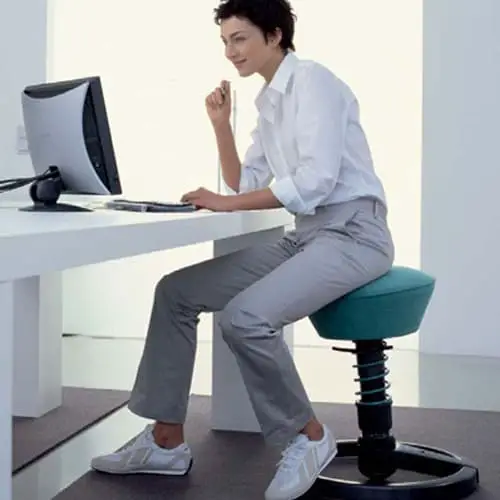
Use an exercise ball for a chair. Unlike sitting in a chair, sitting on an exercise ball engages your core muscles and helps improve balance and flexibility. Occasional bouncing can also help your body interact with gravity to a greater degree than sitting on a stationary chair. But this is a concession and it is still sitting, so standing would be a better option.
Alternatively, use an upright wooden chair with no armrest, which will force you to sit up straight, and encourage shifting your body more frequently than a cushy office chair.
Set a timer to remind you to stand up and move about for at least 10 minutes each hour. You can either walk, stand, or take the opportunity to do a few simple exercises by your desk. For an extensive list of videos demonstrating such exercises, please see my previous article, "Intermittent Movement Benefits Your Health. Here's How to Get More of It into Your Work Day."
Use a standing workstation. For a demonstration on proper posture, whether you're sitting or using a standing workstation, check out Kelly Starrett's video. We are in the process of providing all our employees at mercola.com standing desk options. If you have a sit-down job, I would strongly encourage you to present this information to your employer and get a stand-up desk.
How to Sit Smarter
The evidence is overwhelming at this point—10,000 studies and growing—that prolonged sitting will reduce your lifespan by promoting dozens of chronic diseases, even if you exercise regularly. I've previously recommended standing up and doingexercises at your desk every 10-15 minutes to counteract the ill effects of sitting, but after reading Dr. Levine's book, I'm convinced even that may be insufficient if you're seeking optimal health. I really think the answer is to stand up as much as possible.
That said, sitting is sometimes necessary, so when you do sit following the recommendations by "posture guru" Esther Gokhale can go a long way toward improving posture-related pain associated with prolonged sitting, and will likely help ameliorate the worst risks of sitting. The basics of healthy sitting include the following points:
•Stack sitting: In order to allow the bones in your spine to stack well and permit the muscles alongside them to relax, sit with your behind sticking out behind you, but not exaggeratedly so. Now, when you breathe, each in-and-out breath will automatically lengthen and settle your spine.
This gentle movement stimulates circulation and allows natural healing to go on even while you sit. While conventional advice tells you to tuck in your pelvis to maintain an S-shaped spine, Esther has found that a J-spine is far more natural. A J-spine refers to a posture where your back is straight, your lumbar relatively flat, and your buttocks are protruding slightly. By tucking your pelvis, you lose about a third of the volume in your pelvic cavity, which squishes your internal organs. This can compromise any number of them in a variety of ways.
This is further compounded if you're both "tucked" and "hunched" while sitting. This biomechanically correct posture allows you to move freely, discourages pain, and allows your digestive organs to function without restrictions or blockages.
•Stretch sitting. Another way to elongate your spine is by using your backrest as a traction device. You can see her demonstrate this move in the video below. You will need either a towel or a specially designed traction cushion for this purpose. This simple maneuver brings your back away from the backrest, lengthens your spine, and then roots you higher up against the backrest.
This position helps you maintain an elongated spine, and by getting traction on your discs, you allow them to rehydrate and prevent the nerves from being impinged between your vertebrae. It will also help flatten out your lumbar area, and this alone can sometimes provide immediate pain relief if you have sciatic nerve root pain.
Remember, however, that for optimal health sitting should be your last resort when you have no alternative. It is far better for you to stand than sit. It might take a bit to adjust but once you do it will be every bit as comfortable as sitting. As noted by Dr. Levine, while we clearly need to rest from time to time, that rest is supposed to break up activity—not the other way around. Inactivity—sitting—is not supposed to be a way of life.
Liver is the second largest organ in the human body. In Yellow Emperor's Inner Classic (黃帝内經), liver is described as the Army General in-charge of strategy planning in the body. This is because liver is the main regulator of human internal environment. It produces bile to carry away waste products and break down fats. It also in charge of breaking down and neutralizing toxins in the body. It acts as storage for blood, minerals, nutrients, and glucose and release them as at when our body need extra energy. it regulates immune response and blood clotting. In order to protect your liver, there are several things you may want to avoid:
1. Excessive Sugar
Liver uses fructose to make fat. Excessive refined sugar could lead to fatty liver, which is as harmful to the liver as consuming too much alcohol. Be mindful of what you eat, try to eat natural complex carbohydrates like peas and vegetables. rather than refined sugar such as candy, soda, and pastries. little bit to pamper ourselves is alright, the keyword here is "be subtle". 2. Herbs
Natural does not mean harmless. Always consult a physician before you taking any herbs. Certain herbs may inhibit proper function for your liver. All herbs has to be prescribed after proper diagnosis by physician. One example is kava kava herb used for stress relieving, may cause liver problems after prolonged use.
3. Obesity
Growing too much fat in your liver can cause non-alcoholic fatty liver disease. Your liver will swell and harden over time, leaving your liver scarred. Scarred tissue may no longer be able to function like normal issue. High risk group for fatty liver disease are those with obesity, diabetes or middle-aged people. Proper diet and regular exercise can prevent fatty liver disease.
4. Too Much of Vitamin A (& derivatives)
It is good to consume fruits and vegetables that contain natural vitamin A. Red, orange and yellow fruits and vegetables normally contain plenty of them. However, excessive Vitamin A from supplements may cause liver damage. Our body only need traces of Vitamin A every day, being a fat soluble vitamin, it cannot be excreted through urination. Vitamin A derivatives such as isotretinoin, a drug used to treat acne, may disrupt liver function too.
5. Soft Drinks
Research shows that people who likes to drink soft drinks has higher chance of developing fatty liver disease. If you drink more soft drinks than water, it's time to cut back your consumption.
6. Paracetamol Overdose
Paracetamol is a common drug for pain relief. It is fine to take paracetamol occasionally for headache and fever. Different people have different tolerance to the drug. Always keep your dosage in check as paracetamol overdose is harmful for our liver.
7. Trans Fat Trans fat is very hard to digest and causes fatty liver. At the same time, it also causes bad cholesterol to rise and good cholesterol to drop. Check out the nutrition facts before buying your food products. Trans fat can make you really FAT. 8. Syringe Sharing
Ok. This is really bad for you. All blood transmitted disease can catch up with you this way. Hepatitis C is one of it. So, don't, ever share needle.
9. Alcohol
Almost everyone knows that alcohol is bad for liver. But people did not realize that even without being addicted to alcohol, you can consume more alcohol than you should. many glasses can contain more than standard serving size - 5 ounces of wine, 12 ounces of beer, or 1.5 ounces of liquor. Always practice moderate drinking. In this case, less is better.